Isabella Stephenson
Closing the Gap: Why investigating sex differences in mental health research is crucial
I went to a Neuroscience Colloquium recently where Dr. Liisa Galea presented on the importance of examining sex differences in neuroscience.
She pulled up a photo of Dwayne “The Rock” Johnson on the screen. Then, a photo of Donald Trump beside him. “These two men share 99.9 per cent of the same DNA,” she said. “That 0.1 per cent is clearly quite significant.”
Women and men share on average 98.9 per cent of the same DNA, she informed us as a picture of actor Mindy Kaling appeared. “Imagine the difference that 1.1 per cent makes, then.”
Galea compared using male mental health research for females to using a stove’s manual to fix a fridge. It’s simply not effective, yet research into female’s mental health is incredibly limited. This lacking research can often make it more difficult to diagnose females and gender-diverse individuals with disorders like anxiety and depression.
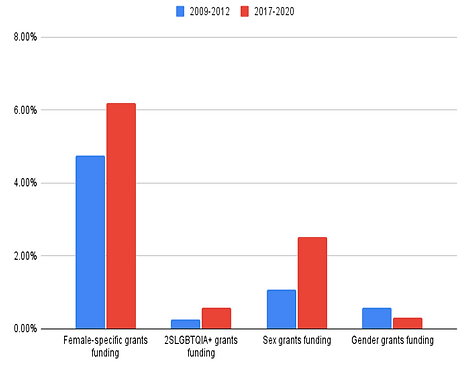
A study by Galea in the Journal of Biology of Sex Differences categorized 8,964 Project and Operating grant abstracts funded by the Canadian Institutes of Health Research between 2009 and 2020. They found that just over five per cent of grant abstracts mentioned sex, and just 0.35 per cent focused on the 2SLGBTQIA+ community. There was a slight improvement between 2009-2012 and 2017-2020. Female-specific grants funding, for example, rose by just 1.43 per cent.
Percentage of grants funding (2009-2012 vs. 2017-2020)
Source: Journal of Biology of Sex Differences
Women have been excluded from health research for decades. They are 17 per cent more likely to die in a car crash because car companies are only required to test vehicle safety on crash dummies modeled after the average man. Women are often dismissed for heart disease, or dismiss symptoms themselves, because they present differently than the male ‘norm.’ The same goes for mental health research.
There aren’t many labs focussing on sex differences in mental health, but Dr. Natalina Salmaso’s is one of them.
For years, Salmaso has researched sex differences in neurodevelopment, neuroplasticity, and psychiatric and neurological diseases. I was lucky enough to participate in some of this research over the past year. I helped with scoring elevated plus mazes, meaning I tracked mice behaviour in maze testing. The mice were both female and male because Salmaso’s lab rarely misses an opportunity to compare sexes.
Her team works tirelessly to better understand diseases like Parkinson’s and mental health disorders like anxiety and depression.
When I ask the lab team why sex differences are often overlooked, they have at least 50 answers for me. The most obvious is that we live in a sexist world where males are seen as the “standard.” Anything deviating from that standard is seen as abnormal.
Interestingly, one of the lab members, Maja Ramljak tells me that people often think of sex differences as women being less smart or capable, and like to say we’re all the same. “No, we’re not,” says Ramljak. “But that’s not a bad thing.”
Ramljak studies sex differences in chronic stress and plasticity as her PhD thesis project. She does this by using a rodent model. “We want to look at the sex differences implicated in chronic stress, and that will give us a better idea of how sex differences play a role in stress, susceptibility to mood disorders, and so forth,” she says.
According to Salmaso, we need to be researching hormonal differences between males and females.
Differences in Hormones
“Our brain is highly responsive to hormones; in fact, hormones are some of the potent transcription factors — so they can change gene expression across the brain,” says Salmaso. “When you have differences in hormones between two sets of people that means that cells in the brain are going to respond quite differently because of those circulating hormones.”
Hormones are the body’s chemical messengers signaling molecules to communicate information from cell to cell and tissue to tissue. Unlike neurotransmitters, hormones can travel from the brain to distant parts of the body. A cell will often change its activities based on that particular message — one of the ways to do this is by adjusting which genes are on or off.
Estrogen, for example, regulates genes responsible for several functions, one of which is maintaining bone health. When estrogen levels drop, bone loss speeds up. Given that estrogen levels drop significantly in females during menopause, women are more likely to experience bone-related diseases like osteoporosis.
There’s also been increased research recently into different hormone cycles in males and females. Females follow an approximate 28-day hormone cycle and males follow a 24-hour cycle. In males, testosterone and energy levels peak in the morning and slowly decrease throughout the day, reaching their lowest point in the evening. In females, hormones and coinciding moods and energy levels follow the menstrual cycle, which is a complex sequence of events that occurs in a female’s body as it prepares for possible pregnancy.
The menstruation phase comes first, when the uterus sheds its lining. During this time, estrogen and progesterone are typically at their lowest. Then is the follicular phase where a follicle is prepared to be released at ovulation. During this time, our follicle stimulating hormone tells the ovaries to prepare an egg for ovulation. The follicle produces estrogen as it grows, but levels of progesterone typically stay lower. During ovulation, an egg is released from the ovaries and enters the fallopian tubes. Estrogen levels peak and drop directly following ovulation. The last phase is the luteal phase, when progesterone levels rise to support potential pregnancy. This fluctuation of hormones can affect energy levels and moods.
A review from the Harvard Review of Psychiatry found that exacerbation of diagnostic symptoms frequently happens in the pre-menstrual (late-luteal) and menstrual phases. Evidence indicates a rise in psychosis, mania, depression, suicide and suicide attempts, and alcohol use. For both healthy women and women with a depressive disorder, the review found a pre-menstrual increase in depressive symptoms.
When looking at hormones in males and females, Salmaso says we need to examine these differences. “A lot of drugs or treatments that we’re coming up with — we’re trying to be more and more specific so people don’t get massive side effects. Now, people can take a drug that’s specific to their cancer, mood disorder, whatever their condition is. So if males and females are doing that in a very specific way, and you only test in males, you may have a completely different effect in females,” she says.
For example, research suggests that serotonin reuptake inhibitors (SSRIs) are more effective in females to treat depression, while males tend to respond better to tricyclic antidepressant medications. Oftentimes, males also need a higher dosage than females. Providing females with a similar dose could result in harmful side effects. A study in the Biology of Sex Differences found that women experience adverse drug effects nearly twice as often as men.
Epigenetic and Social Changes
It’s not simply about examining hormones. Life experience can affect hormone levels and change gene expression; this is called epigenetics.
When we face a threat, an alarm system goes off in the body. Through nerve and hormonal signals, the system prompts the hypothalamic-pituitary-adrenal axis (HPA) to release hormones like cortisol, our primary stress hormone. Cortisol increases the amount of substances in the body available to repair tissues, and it slows functions that would be harmful in a fight-or-flight situation, like suppressing the immune and digestive systems. Usually, once the threat has passed, hormones return to typical levels and systems go back to their regular activities.
But, when stressors are a day-to-day reality, the reaction stays turned on. Chronic stress can disrupt many of the body’s processes.
An article in the Journal of Neuropsychiatry looked at the link between stress and depression. They found that adverse early-life events have been shown to cause changes in the developing brain. Experiences of stress in adulthood can activate these stress responses developed in childhood, leading to anxiety and depression. Hyperactivity in the HPA system, and increased levels of hormones like cortisol, could lead to epigenetic changes that, through a complex set of pathways, links stress to depression.
Isabeau Welter is a counselor at Carleton University who takes an anti-oppressive approach to her therapy. In other words, Welter takes into account the power structures influencing an individual’s mental health.
She says it’s important to acknowledge lived gendered experiences as one factor and sex and hormones as another.
According to Statistics Canada, 59 per cent of lesbian, gay, and bisexual people have been physically or sexually assaulted, and nearly half of Black women experienced discrimination or unfair treatment according to the 2019 General Social Survey on Canadian’s Safety. Harassment, discrimination, and assault are examples of lived stressful experiences that disproportionately affect people of colour and members of the 2SLGBTQIA+ community.
Welter’s anti-oppression approach to therapy attempts to acknowledge this lived experience. “Often people’s experiences of mental health and trauma are shaped by larger power structures and systems of oppression — things like homophobia, transphobia, gender-based violence, the patriarchy, and racism, among others,” she says.
Diagnostic Process
When I ask if Welter finds research into women and gender-diverse individuals’ health lacking, Welter scoffs. “100 per cent,” she says. “Without a doubt, especially when we look at the traditional diagnostic tools.” Welter says the lack of research makes diagnosis and treatment more difficult.
Welter says Attention-Deficit/Hyperactivity Disorder (ADHD) is a good condition with which to analyze differences. “Women and gender diverse folks expressing it when they’re younger is very different and not usually addressed or acknowledged. There’s this social expectation that while a young girl may be struggling, she’s often been socialized not to be loud and rambunctious. So, it shows up differently than what we would historically think of as that rambunctious, hyperactive presentation.”
Boys are three times more likely to be diagnosed with ADHD than girls, and research suggests that up to 75 per cent of girls with attention problems go undiagnosed.
Because there’s still limited research into females and gender-diverse individuals, Welter says this can skew the diagnostic process. “With women and gender diverse folks there’s often this notion of being dramatic or overly emotional.”
As for Salmaso, she says the symptoms for depression, for example, are usually different between males and females. “You’re more likely with males to get irritability and anger and things like that, whereas with females you get that sad phenotype.”
According to a study in the Journal of Affective Disorders, Major Depressive Disorder (MDD) is more common in females than males. Females tend to report symptoms like weight gain and hypersomnia (excessive sleepiness) which according to the Diagnostic and Statistical Manual of Mental Disorders are considered “atypical depression.” They also tend to report more somatic symptoms, like gastrointestinal symptoms and a loss of appetite. Meanwhile, males present more often with impulse control problems and substance use. Their research points towards the importance of symptom-level approaches in depression research and treatment.
Ramljak says we need to change our focus. “It takes on average a couple years for women to get diagnosed. Men get diagnosed on average earlier than women, because we don’t even know how certain diseases or conditions or disorders present in women, because we’re so focused on that male defect.”
As for Salmaso, she says scientists have a responsibility. “I think as scientists we’re missing a really important opportunity to not look at males and females. We’re often looking at things that are different to understand what’s happening in a disease. We’re looking for that one person who took a drug that was different from the others who got cured and then we try to understand what did that [drug] do,” she says. “Males and females are responding differently so we have innate comparison that we can make.”
“About half of the population is female, we should not be ignoring them… Just like we shouldn’t be ignoring race or ethnicity or sexual orientation.”